


Understanding the Basics
OSHA Air Gun Compliance Explained
OSHA's primary concerns for compressed air safety are Output Pressure, Noise Exposure, and Chip-Guarding.
30 PSI Output Pressure Requirement
Most pneumatic tools, including air guns, require high pressure to operate effectively. OSHA requires that when an air gun is dead-ended, the static output pressure at the point of blockage may not exceed 30 PSI.
Occupational Noise Exposure
Compressed air can contribute to high workplace noise levels. Proper air gun selection, including models with noise-suppression nozzles, can help support a safer work environment.
Effective Chip Guarding
When using compressed air for close-in cleaning, OSHA requires effective chip guarding to help protect workers from flying debris and particle blowback.
Common Misconception About 30 PSI
The 30 PSI requirement does not mean reducing plant air line pressure to 30 PSI. It refers to the static output pressure at the point of blockage when the air gun is dead-ended. What the video to learn more.
Air Gun Safety in the Workplace
This 8-minute safety video identifies potentially dangerous workplace practices related to aur gun usage, outlines corrective actions, and covers steps to ensure OSHA compliance.
Regulations Reference
OSHA Standards by Industry
The safe use of pneumatic tools in the workplace, including safety air guns, are governed under several OSHA Regulations. Standards for General Industry are listed below and apply across all classes of end-users. Standards for Shipyards, Marine Terminals and Construction are also shown below and apply to these sub-classes.
Occupational Health and Environmental Control
Occupational Noise Exposure
OSHA STANDARD 1910.95
Hand and Portable Powered Tools and Equipment, General
Compressed Air Used for Cleaning
OSHA STANDARD 1910.242(b)
Instruction for OSHA Standard 1910.242(b)
Reduction of Air Pressure below 30 psi for Cleaning Purposes
STD 01-13-001
Tools and Related Equipment
General Precautions
OSHA STANDARD 1915.131
Related Terminal Operations and Equipment
Compressed Air
OSHA STANDARD 1917.154
Power Operated Hand Tools
Pneumatic Power Tools
OSHA STANDARD 1926.302
-
-

Noise Reduction
Noise-suppression options for quieter compressed air cleaning.
-


Control Silica Dust
Respirable Crystalline Silica Standard
In 2019, OSHA updated its Respirable Crystalline Silica Standard (29 CFR 1926.1153) to protect construction workers from exposure to silica dust.
The rule sets a permissible exposure limit (PEL) of 25 µg/m³ over an 8-hour time-weighted average and requires employers to use effective dust control methods.
Guardair PulseAir Dust Extractors are engineered to help meet these requirements with powerful, compressed air–driven performance and a proprietary, button-activated filter cleaning system—allowing continuous operation without opening the unit.
To meet OSHA requirements, dust collectors must include:
✔ Filtration with 99% or greater efficiency (HEPA)
✔ Filter-cleaning mechanism

Free Resources
OSHA Compliance Kit & Downloads
Everything you need to achieve and maintain OSHA compliance in your facility.
Free OSHA Compliance Kit
With the contents of this kit, you'll be well on your way towards meeting OSHA Standards when cleaning with compressed air in your facility.
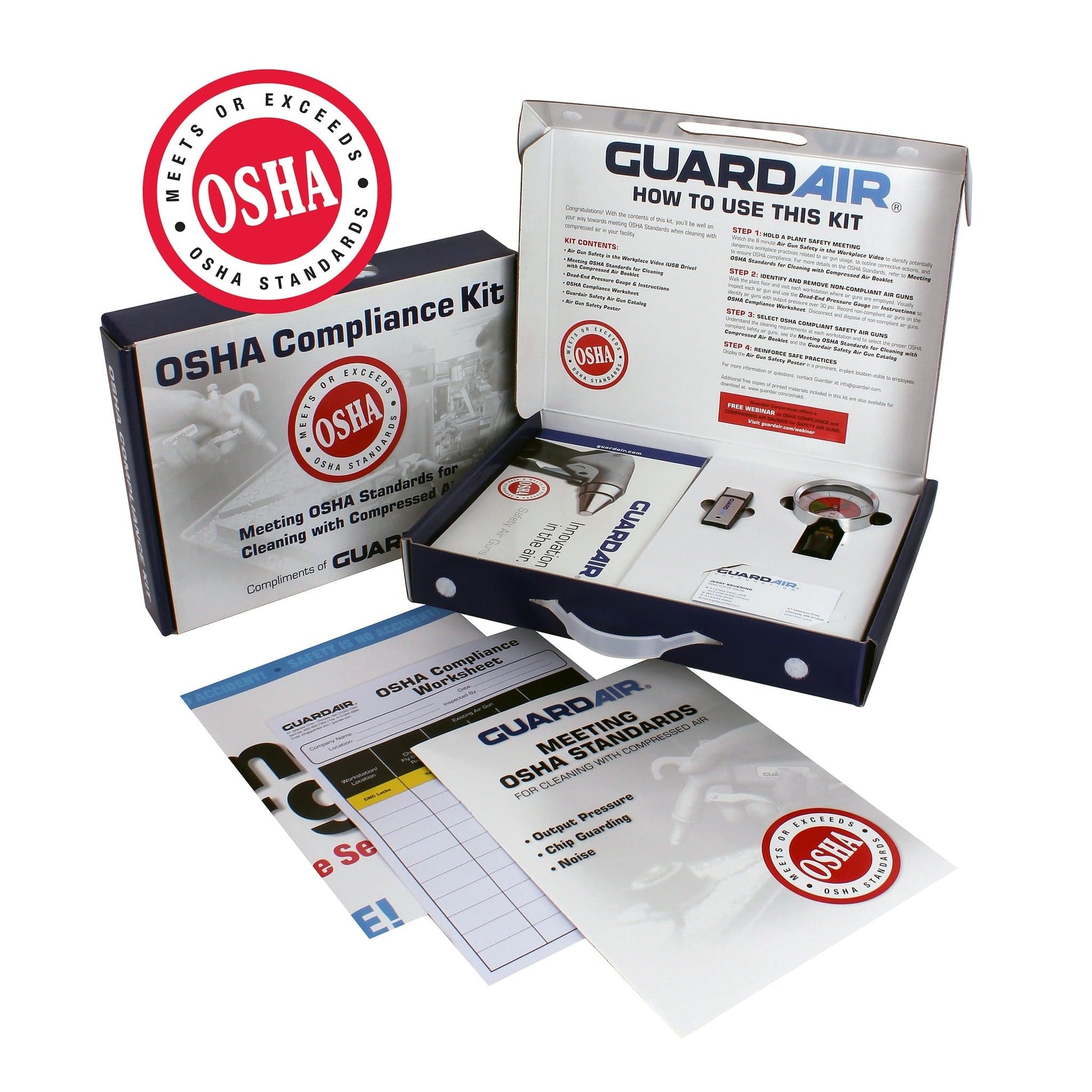
✔ Air Gun Safety in the Workplace Video
✔ Meeting OSHA Standards Booklet
✔ Dead-End Air Pressure Gauge & Instructions
✔ OSHA Compliance Worksheet
✔ Compressed Air Consumption Worksheet
✔ Guardair Safety Air Gun Catalog
✔ Air Gun Safety Poster
Videos
Document Downloads
Facility Assessments
Free On-Site Audits
Identify safety risks, improve compliance, and reduce compressed air costs with a Guardair on-site audit.
OSHA Compliance Audit
Are your air guns OSHA compliant?
Schedule a visit with a Guardair team member to conduct a plant-wide OSHA Compliance Audit. We evaluate compressed air cleaning stations and identify potential safety and compliance risks.
Compressed Air Audit
Are you wasting expensive compressed air?
Guardair will assess your facility's compressed air usage and identify opportunities to reduce consumption and improve efficiency.
-
What OSHA standards govern the use of air guns?
For General Industry, two OSHA standards are of primary relevance to air gun users.
- The first standard focuses on permissible noise exposure covered under 29CFR Part 1910.95 (a) Occupational Noise Exposure.
- The second standard focuses on the use of compressed air used for cleaning covered under 29CFR Part 1910.242 (b) Hand and Portable Powered Tools and Equipment, General.
What does OSHA 1910.242(b) require?
OSHA Standard 1910.242(b) states: "Compressed air shall not be used for cleaning purposes except where reduced to less than 30 PSI and then only with effective chip guarding and personal protective equipment." The 30 PSI limit applies to "dead-end" pressure - when the nozzle is blocked against a surface or skin.
Do I need to reduce my line pressure to 30 PSI?
No. This is popular misconception and is not necessary for compliance. To meet this requirement, use an air gun that is properly engineered. All Guardair safety air guns meet this standard.
How can Guardair safety air guns help meet the OSHA standard for noise?
While occupational noise can be generated from a wide variety of sources, the use of a low noise safety air gun can be an important component in moving towards noise compliance. Guardair safety air guns featuring WhisperJet and QuietForce nozzles provide proprietary, noise limiting technology.
Visit Our Air Gun FAQ PageHow do Guardair safety air guns meet the OSHA standard for output pressure?
All Guardair safety air guns meet this standard by incorporating OSHA compliant, proprietary nozzles into their design. These include Venturi, AirMiser, Air Shield, WhisperJet, and QuietForce type nozzles.
Ready to Get Compliant?
Order your free OSHA Compliance Kit or speak with our team today.